Teaching tool · Live demo
Watch an emergency department bottleneck form.
It is hard to see how staffing, demand, and the wait for an inpatient bed combine into long waits, boarding, and patients who leave without being seen. This simulation lets you change one thing at a time and watch what happens.
three.js r128JavaScriptOne HTML fileNo build step
01 · At a glance
The question, the data, and the terms.
This is a teaching and exploration tool, not a planning or clinical tool. Every patient in it is generated.
- The question
- How do arrivals, staffing, and inpatient bed waits turn into a bottleneck in the emergency department?
- Who it’s for
- ED and nursing leaders, operations staff, and students, as a way to teach and explore patient flow.
- Data
- No real data. All patients and timings are generated. The parameters are illustrative and are not calibrated to any real hospital.
- Status
- A working teaching tool, with a live demo.
- License
- No license is stated in the repository.
02 · What it does
A 15-bed department you can push on.
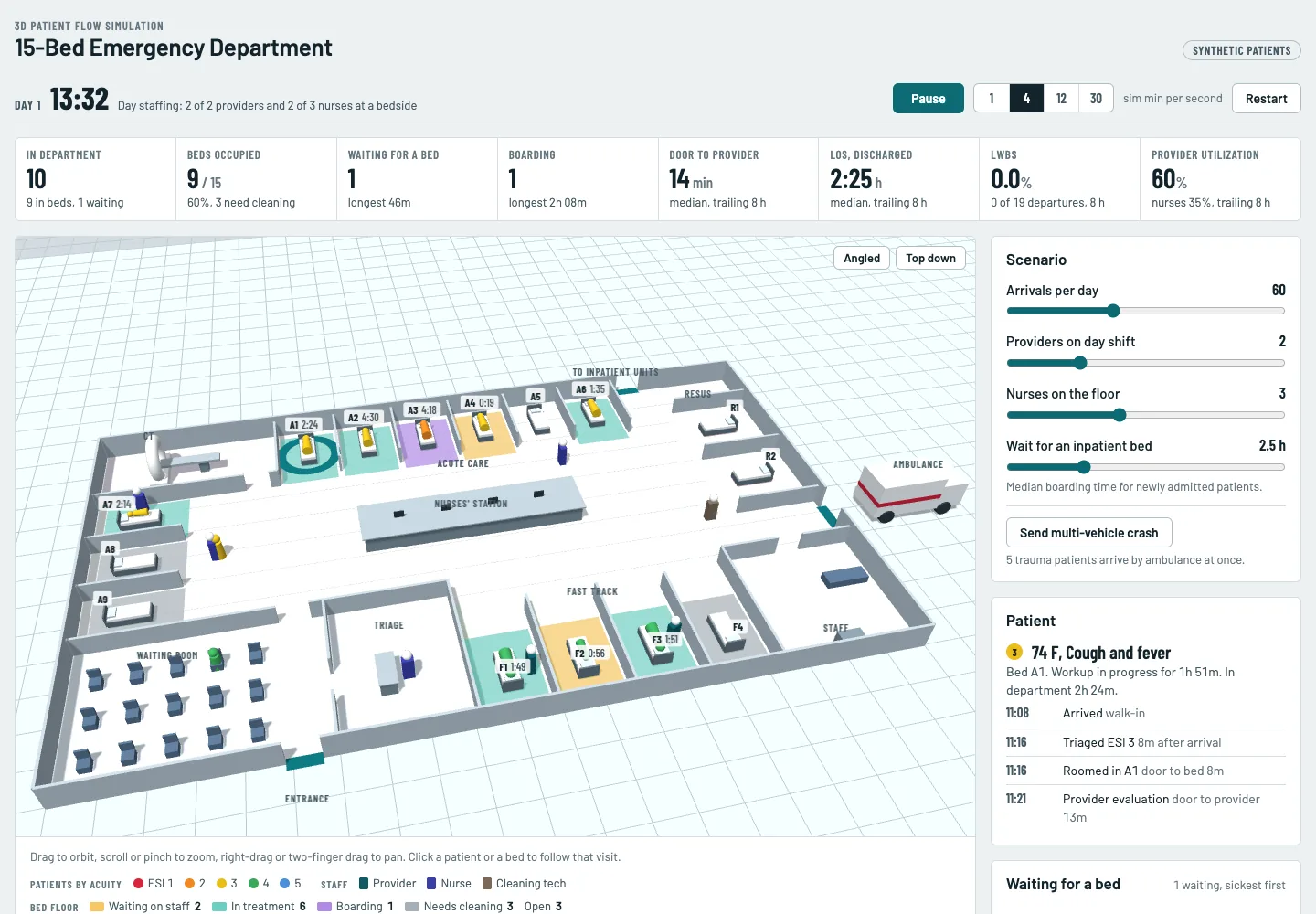
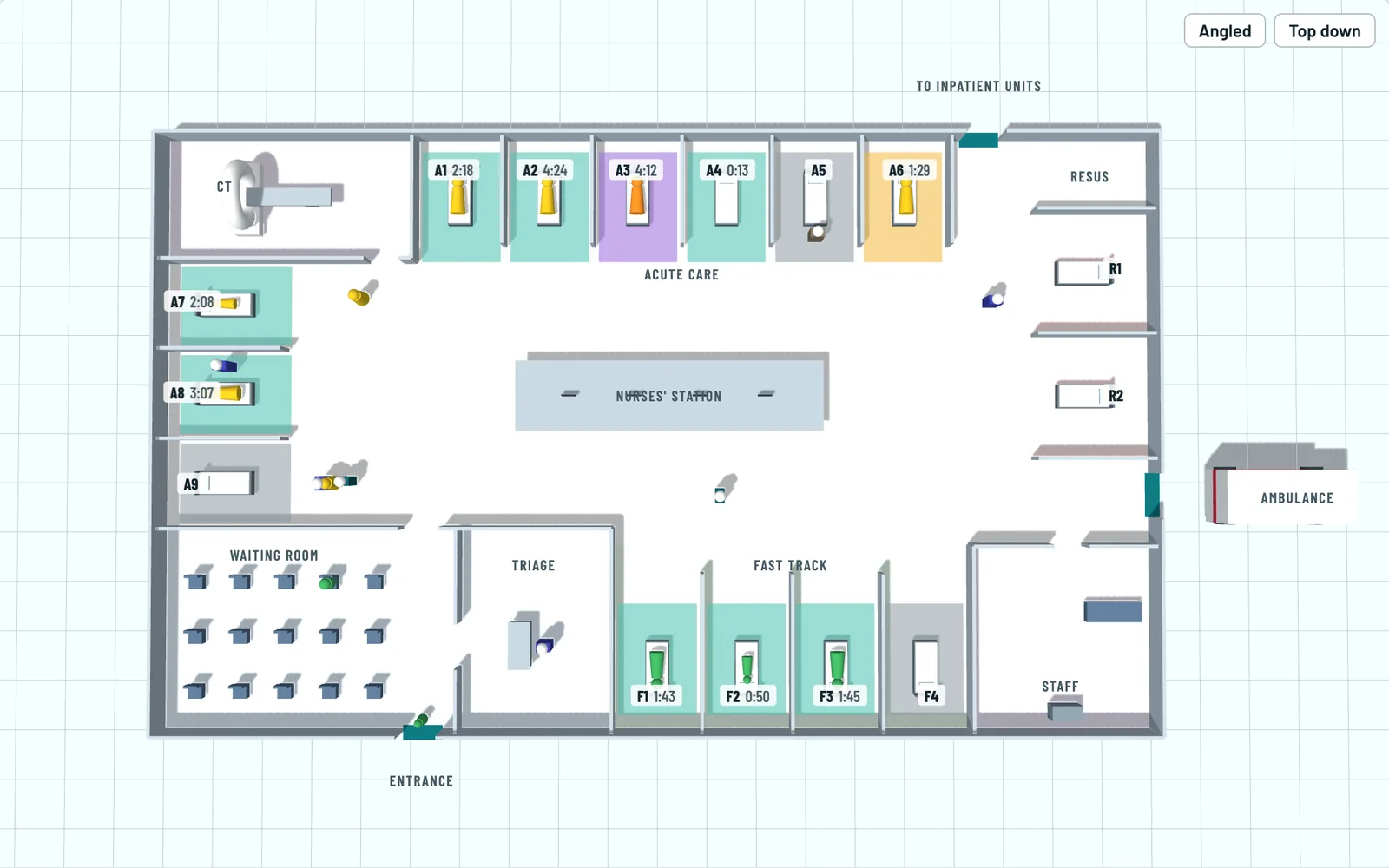
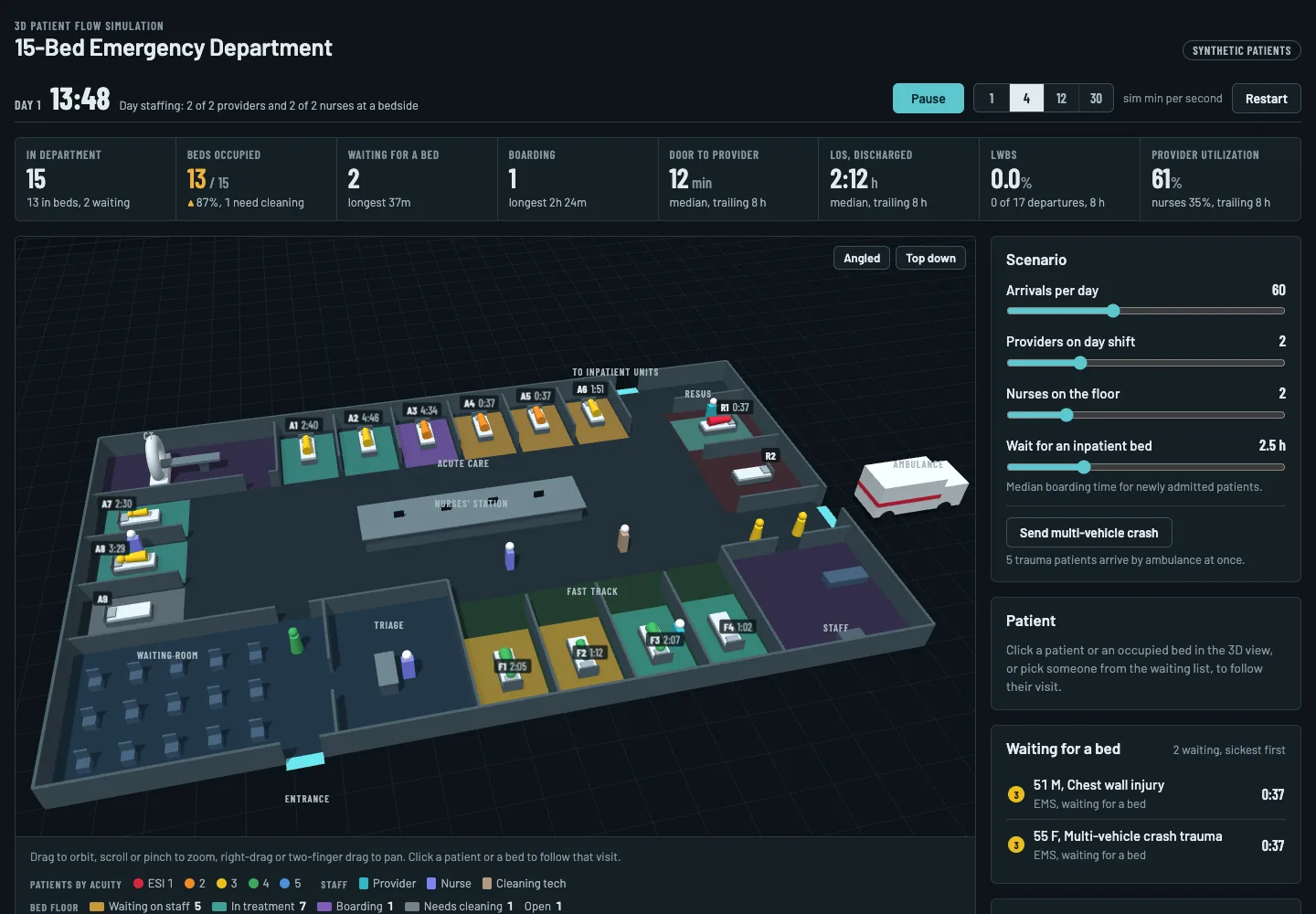
The model follows each patient from arrival through triage, a bed, a nurse, a provider, CT, and then discharge or admission.
- A
The department
2 resuscitation beds, 9 acute care beds, and 4 fast-track beds, plus one triage room and one CT scanner.
- B
What you can change
Arrivals, from 30 to 110 a day. The number of providers and nurses. The wait for an inpatient bed. You can also send a five-patient multi-vehicle crash.
- C
What it measures
Door-to-provider time, length of stay, the rate of patients who leave without being seen, and boarding.
03 · What it shows
An illustration, not a prediction.
With one provider and one nurse, a three-day run of the model gives median door-to-provider times over 100 minutes, and between 5% and 21% of patients leave without being seen. That is an illustration from a model with unfitted parameters. It is not a finding about real emergency departments.
04 · Limits
Don’t staff a department from this.
The project’s own documentation calls it “a teaching and exploration tool, not a planning or clinical tool.”
- The parameters are plausible defaults, not fitted to data. Do not read the outputs as predictions for a real department.
- It is simplified. There are no nurse-to-patient ratios, breaks, or shift handovers. There are no consultants, hallway beds, or pediatric or behavioral health areas. There are no deaths or transfers, and walking takes no simulated time.
- Only CT is modelled as a shared resource.
- It was checked in headless Chrome on macOS only.
- The live demo needs an internet connection to load three.js and fonts, and WebGL for the 3D view.
Open it and move a slider.
The demo runs in your browser. The whole thing is one HTML file, with no build step.